Understanding the biology behind Digestive Stability
Microbiome Management starts with the gut environment that lets beneficial microbes grow, stabilize and work consistently over time.
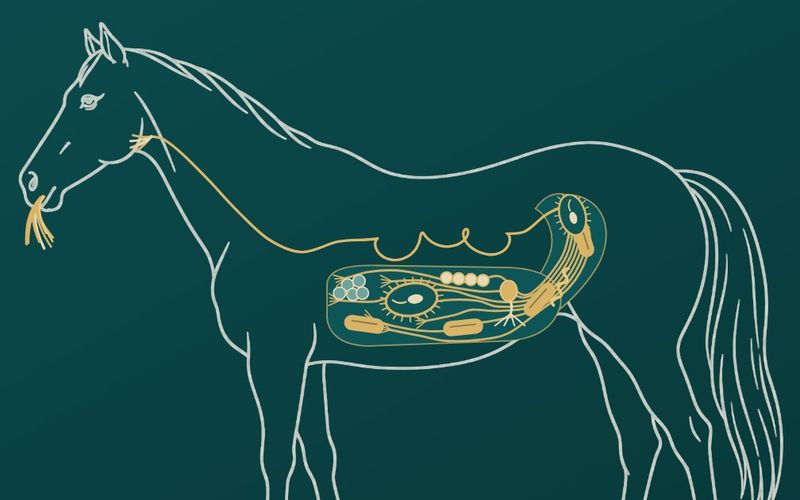
Inside the equine digestive tract
A horse is built to live on forage, yet its own enzymes cannot break down fiber. That work belongs to the microbes of the hindgut, the cecum and colon, which together hold more than half of the tract's capacity.1,2
Foregut: the horse's own digestion
- StomachAbout 10%Mixing, gastric acid and the start of protein digestion.
- Small intestineAbout 28%The horse's own enzymes digest protein, fat and starch, and the nutrients are absorbed.
Hindgut: microbial fermentation
- Cecum12 to 15%Microbial fermentation of fiber begins.
- Large colon40 to 50% with the small colonFermentation continues, and nutrients and water are absorbed.
- Small colonWater recovery continues and fecal balls form.
Magnified: inside the colon
A community at work on fiber
Fiber reaches the hindgut largely intact. A mixed community of microbes ferments it, and the horse absorbs what they make.2,3
- Fiber. Fragments of plant cell wall that reach the hindgut largely intact, because the horse's own enzymes cannot break them.
- Bacteria. The main fermenters of fiber, many of them working attached to its surface.
- Archaea. Single cells distinct from bacteria. In the gut, many use the hydrogen that fermentation leaves behind.
- Anaerobic fungi. Thought to be among the stronger fiber degraders, rooting into plant fragments as they work.
- Ciliate protozoa. Single cells much larger than bacteria, living among the fiber.
- Volatile fatty acids. Acetate, propionate and butyrate, absorbed across the gut wall and used for energy.
The conditions in the hindgut decide how well this community works. That is where Microbiome Management begins, and where Digestive Stability is built.
What happens at each stage
Each stage performs a different biological function. Together, they create Digestive Stability.
-
Microbiome Management
The foundation
What it is: The biological framework for understanding how Digestive Stability is created.
Why it matters: It ensures the right conditions exist for beneficial microbes to survive and function.
-
-
Microbial activity
The engine
What it is: Beneficial microbes ferment fiber, break down compounds, and produce essential nutrients.2
Why it matters: It powers the biological processes that support digestion and whole body condition.
-
Digestive Stability
The outcome
What it is: The result of a healthy environment and consistent microbial activity working together over time.
Why it matters: It creates consistent digestion, efficient nutrient use, hydration, and biological resilience.
-
Observable signals
The reflection
What it is: The visible and measurable signs that Digestive Stability is present, or absent.
Why it matters: These signals reflect the condition of the system upstream.
Everything downstream depends on what happens upstream.That is why Microbiome Management begins with the gut environment.
Different approaches support digestion at different biological levels
Some approaches add beneficial microbes,8 some add nutrients for them and some help during stress.
Microbiome Management works on the environment that decides how well each of them performs.
Understanding where each strategy fits helps explain why improvements sometimes hold, and why they sometimes do not.
Reset and Stabilize for 30 days. Then Maintain, every day.
The same formula is used throughout. The amount and purpose of the feeding stage change.
-
Reset
Days 1 to 10
6 mL per 45 kg (100 lbs) daily
A higher starting amount opens the routine. It gives the gut environment a strong first ten days of support while Humequine becomes part of the daily ration: more bioavailable carbon for beneficial bacteria, and more humic and fulvic acid at work from the start.
Your part Begin the routine, measure consistently and note your horse’s starting patterns.
-
Stabilize
Days 11 to 30
4 mL per 45 kg (100 lbs) daily
A steady daily amount builds a consistent routine. The microbial community in the hindgut responds to what a horse eats over days and weeks, so twenty steady days, through day 30, are what let a new pattern take hold and let you see whether it holds.
Horse with digestive issues: stay on the Stabilize amount until manure has been consistent for 10 days in a row, then move to the maintenance dose.
Your part Keep the amount consistent. Note changes in forage, workload, travel and management next to what you observe.
-
Where your horse stays
Maintain
Day 31 onward
Leisure or light work 2 mL per 45 kg (100 lbs) dailyPerformance or high exertion 4 mL per 45 kg (100 lbs) daily
From here Humequine is part of everyday care, not a course that ends. Feed, forage, weather and work keep changing, and the gut environment meets every one of those changes. Daily support keeps the conditions for Digestive Stability in place, and observation continues.
Your part Use the daily amount that fits your horse’s work, and reassess when their needs change.
Plus a Seasonal Reset every six months, as the seasons turn: ten days at the Reset amount, then back to Maintain.
For performance horses, the maintenance amount is the same as Stabilize.
These are feeding stages, not deadlines for results.
How the formula fits into the routine
Every stage uses the same three functions.
-
Carbon fuels beneficial bacteria
Beneficial bacteria need carbon to grow and do their work. Humequine supplies it in a bioavailable form, supporting the microbial activity at the centre of a stable gut environment.
-
Humic acid binds
Humic acid binds to unwanted compounds in the gut, supporting natural detoxification. It helps keep the environment beneficial microbes live in clear and balanced.
-
Fulvic acid delivers
Fulvic acid binds to nutrients and water molecules for enhanced absorption and hydration, helping your horse make use of what the ration already provides.
Questions about the routine
Does Reset mean a cleanse?
No. “Cleanse” is a marketing word that often gets misunderstood, and we take a more direct approach to Digestive Stability. Reset is a stronger first ten days of the same daily formula, giving all three functions more to work with as the routine begins: bioavailable carbon fuels the growth of beneficial bacteria, humic acid binds to unwanted compounds supporting natural detoxification, and fulvic acid binds to nutrients and water molecules for enhanced absorption and hydration. Together they support the environment that beneficial bacteria need, which is the heart of Microbiome Management.
Why continue beyond the first good week?
A good start is encouraging, and the gut environment keeps meeting new feed, forage, weather and work after it. Stabilize gives the routine steady weeks to take hold, and Maintain keeps the conditions for Digestive Stability in place from then on.
Do you ever repeat Reset or Stabilize, or stay on Maintain?
Maintain is the everyday routine, and we recommend a Seasonal Reset every six months, as the seasons turn. Fresh spring grass and the move back to hay in the fall change what reaches the hindgut, and the microbial community there shifts with the diet over days and weeks. A ten-day Reset at those turns gives the gut environment extra support while the new forage settles in. Then it’s back to Maintain.
It’s part of the Microbiome Management Framework: steady daily care with Humequine helps maintain Digestive Stability, and a Seasonal Reset meets the seasons as they change. You know your horse, so a Reset can also help around any other big change.
Digestive Stability exists on a spectrum.
Digestive Stability is rarely all or nothing.9 The scale shows where a horse sits today, and whether a change is holding.
Persistent or worsening digestive changes deserve veterinary assessment.
Less stable More stable
Highly variable
Digestive function is frequently inconsistent. Instability is common and unpredictable.
Inconsistent
Patterns of instability occur regularly. Improvement happens, but does not last.
Improving
Conditions are improving. More consistent function with fewer and less severe setbacks.
Mostly stable
Digestive function is generally consistent. Occasional disruptions but recovery is faster.
Fully stable
Consistent digestive function with minimal disruption. Resilient across stress and challenges.
The six pillars of Microbiome Management
Six articles from the Humequine Learning Center, in reading order. If there is a topic you would like us to cover, tell us.
-
 Pillar 01Microbiome Management for horsesThe framework, conditions first, and why digestive improvements so often fade.Read the article
-
 Pillar 02The equine microbiome and the hindgutFollow a flake of hay through the digestive tract to the microbes that turn forage into energy.Read the article
-
 Pillar 03Digestive Stability: whether a change holdsHow to read your horse's baseline, and judge a change by whether it holds, not by the first good day.Read the article
-
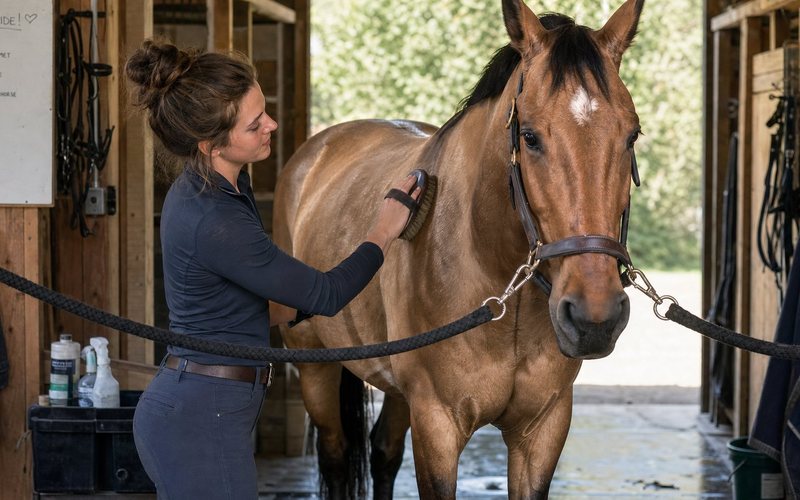 Pillar 04Horse manure and digestive changesHow to describe what you see, and what a pile can and cannot tell you.Read the article
-
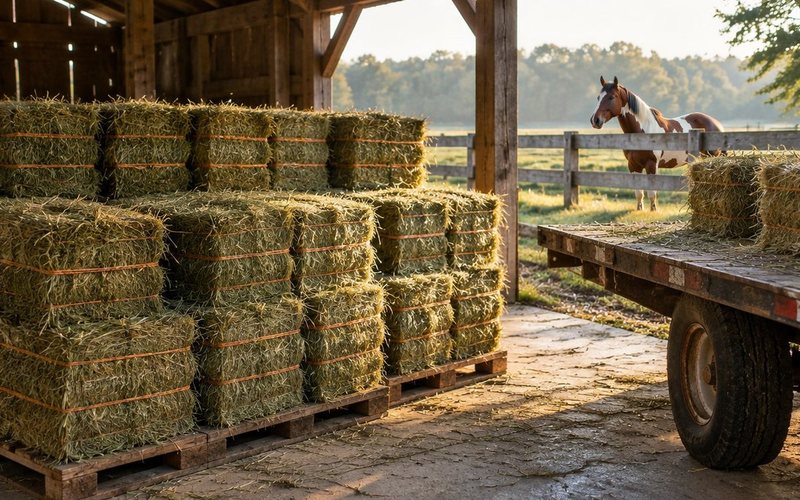 Pillar 05Gut health, built dailyOne ordinary barn day, and what each decision does to the gut environment.Read the article
-
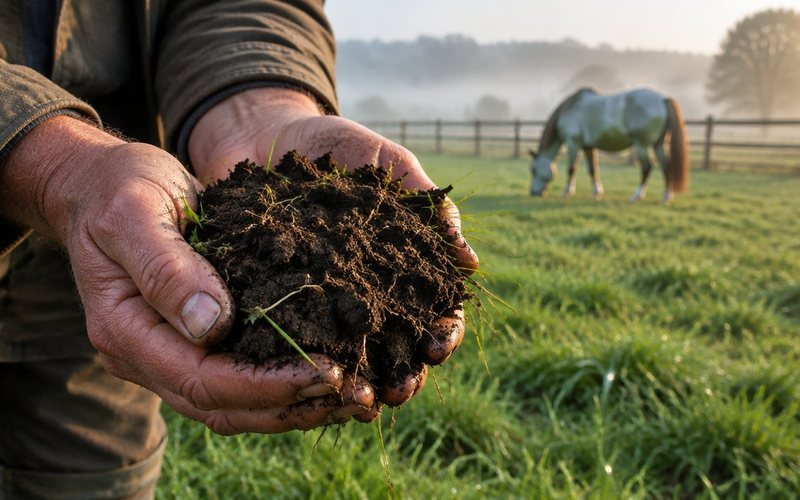 Pillar 06Humic acid, fulvic acid and carbon: the evidenceWhat the research shows, which animals it was done in, and how far it reaches your horse.Read the article
Supporting research
The sources behind this page, with a short note on what each one shows. The small numbers in the text above link here.
-
01 How much of the tract each organ holds
Iowa State University Extension gives each part of the tract's share of total digestive capacity: stomach about 10%, small intestine about 28%, cecum 12 to 15%, and the large and small colon together 40 to 50%.
Iowa State University Extension and Outreach. Synopsis of the Digestive Anatomy and Physiology of the Horse. Read the source (opens in a new tab)
-
02 How the hindgut turns fiber into energy
Horses cannot break down fiber with their own enzymes. Microbes in the cecum and large colon ferment it into volatile fatty acids, which the horse absorbs and uses for energy.
University of Maryland Extension. Teaching Basic Equine Nutrition Part II: Equine Digestive Anatomy and Physiology. Read the source (opens in a new tab)
-
03 A hindgut community of many kinds
Studies that look at more than one kingdom of microbe in equine manure find a wider community than bacteria alone. This one characterized the core fecal community across several horse and pony groups.
Edwards JE, Shetty SA, van den Berg P, and colleagues. Multi-kingdom characterization of the core equine fecal microbiota based on multiple equine (sub)species. Animal Microbiome. 2020;2:6. Read the source (opens in a new tab)
-
04 Each region of the gut hosts its own community
Researchers mapped seven regions of the healthy equine digestive tract and found a different microbial community at each site. Conditions inside the gut differ from region to region, and so do the microbes living there.
Ericsson AC, Johnson PJ, Lopes MA, Perry SC, Lanter HR. A Microbiological Map of the Healthy Equine Gastrointestinal Tract. PLOS ONE. 2016;11(11):e0166523. Read the source (opens in a new tab)
-
05 A change of forage changes the gut community
Ponies moved abruptly between grass and hay showed clear changes in their fecal microbiota. What a horse eats sets the conditions in the hindgut, and the community responds.
Garber A, Hastie P, McGuinness D, Malarange P, Murray JA. Abrupt dietary changes between grass and hay alter faecal microbiota of ponies. PLOS ONE. 2020;15(8):e0237869. Read the source (opens in a new tab)
-
06 Fulvic acid and the gut community in hens
In 252 laying hens, adding fulvic acid to the feed shifted the balance of the gut microbial community. This is poultry research, and it shows that a gut community can respond when the compound is fed.
Xiao G, Liu S, Yan X, Yang Y, Qi Q, Feng X, Gong L, Zhang H. Effects of fulvic acid addition on laying performance, biochemical indices, and gut microbiota of aged hens. Frontiers in Veterinary Science. 2022;9:953564. Read the source (opens in a new tab)
-
07 Humic substances in a laboratory gut model
In a laboratory model of the rumen fed hay and concentrate, humic substances lowered ammonia production as the dose rose, while the overall microbial community stayed largely the same. The response depended on dose and setting.
Terry SA, Ramos AFO, Holman DB, McAllister TA, Breves G, Chaves AV. Humic substances alter ammonia production and the microbial populations within a RUSITEC fed a mixed hay and concentrate diet. Frontiers in Microbiology. 2018;9:1410. Read the source (opens in a new tab)
-
08 What probiotic studies in horses measure
This study examined commercial oral probiotic supplements in horses and their effect on gut barrier function. Probiotic results belong to the specific product, the horses studied and the outcome measured.
Żak-Bochęnek A, Żebrowska-Różańska P, Bajzert J, and colleagues. Investigating the potential immunomodulatory effects of commercial oral probiotic supplements on equine gastrointestinal tract barrier function. Frontiers in Immunology. 2025;15:1487664. Read the source (opens in a new tab)
-
09 Change shows in days, settling takes weeks
Twelve horses went through two abrupt diet changes in a row. Fiber-degrading activity shifted within two days, and after the return to fiber the fecal measures took three to four weeks to settle back.
Collinet A, Grimm P, Julliand S, Julliand V. Sequential Modulation of the Equine Fecal Microbiota and Fibrolytic Capacity Following Two Consecutive Abrupt Dietary Changes and Bacterial Supplementation. Animals. 2021;11(5):1278. Read the source (opens in a new tab)
-
10 What humic and fulvic substances are
Humic substances are major components of the natural organic matter in soil and water, formed as plant and microbial remains decay and transform. They influence how chemical elements cycle and become available in soils and waters.
International Humic Substances Society. What are humic substances? Read the source (opens in a new tab)

Take the framework back to the barn
The Microbiome Management Guide for horses, 16 pages. Why digestion improves and then slips back, and what the gut environment needs to become more stable.
Microbiome Management creates Digestive Stability
Digestive Stability is not created by adding more. It is created by supporting the biological environment that beneficial microbes depend on. Humequine is how we support that environment, every day.